|
While Federal standards for traffic radar were proposed in the past, they have
never been implemented. However, in an attempt to reduce radar errors, several local governments
used the Federal research to develop better training programs.
The Texas Department of Public Safety produced a comprehensive manual based on
the Federal tests. It cautions operators, "...the radar does not generate 'false' readings.
Any time a reading appears, the radar has sensed a signal. The radar operator must be familiar with
situations that can produce 'error' readings." If the operator does not detect the error, a
ticket will be wrongfully issued.
Here are the radar "errors" detailed by the Texas manual:
1. Antenna Positioning Error
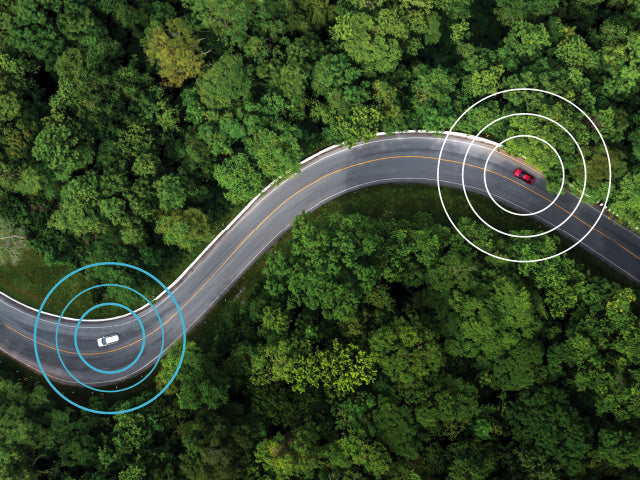
The radar beam travels in a straight line, neither bending around curves nor
following the contour of hilly terrain. If the antenna is not properly positioned, it may seem to
clock an approaching car when, in fact, it's clocking another car in the background.
2. Look-Past Error
Even if the operator aims his antenna properly, radar is still subject to
"look-past" error. This is caused by the radar looking past a small reflection in the
foreground to read a larger reflection behind. This error is all the more insidious because
poorly-trained operators assume it can't happen.
Texas instructors warn, "It is a widely-held misconception that the reflected
target signal received by the radar antenna will always be that of the closest vehicle to the
antenna. There are times, due to traffic conditions, that the closest vehicle is not returning the
strongest signal."
Evidence of the potential size of this error appeared in Car and Driver (October,
1979). The author measured the effective range of a Kustom Signals KR11 traffic radar against
various vehicles. The typical small sedan did not show up on the radar until it was less than 1200
feet away from the antenna, but the same radar unit locked on to a Ford 9000 semi at 7600 feet.
This shows how common vehicles reflect microwaves differently.
The Texas instructors confirm this problem with radar, saying "It is not
unfair to say that the reading you register could be a larger, better target three-quarters of a
mile down the road."
3. Vehicle Interference Error
Because moving radar tries to do a more complicated jog than stationary radar, it
is subject to all the errors of stationary radar, plus several additional errors that apply to it
alone.
"Vehicle interference" error occurs when moving radar is used in
traffic. For example, traffic ahead can confuse the radar's estimate of patrol speed. Moving radar
calculates target speed by subtracting patrol speed from the closing speed of the target. Therefore,
anything that produces a low evaluation of patrol speed will automatically result in a high speed
reading of target speed.
Texas tells its radar operators that this "...situation becomes more critical
if difference in patrol speed and interference-vehicle speed is five to ten mph. A target vehicle
moving 61 mph may be recorded at 66-71. These borderline speeds are more difficult to detect with
the eye."
4. Cosine Error
Cosine error produces a result similar to Interference error except no moving
traffic need be present. A stationary object adjacent to the road, such as a building, or road
machinery, or even a sign, makes a more efficient reflector than horizontal pavement. Therefore the
radar uses that reflection as the basis of patrol speed.
If this reflector were positioned straight ahead on a collision path, the patrol
speed estimate would be close enough. But the further the object is located off a direct line to the
target, the lower will be the estimate of patrol speed. This is a simple trigonometry problem
relating to the cosine of the angle between the target and the ground reflector, hence the name
Cosine error. Since Cosine error always makes patrol speed seem smaller than it actually is, it
always acts to raise the reading of target speed.
5. Double-Bounce Error
Microwaves are easily reflected. That's what makes radar possible. But the
operator must be aware of the difference between an ordinary reflection and a bad bounce. Big
objects such as trucks are very efficient reflectors, and it's possible for the radar beam to bounce
off several moving trucks at once, always producing erroneous readings.
6. Beam-Reflection error
Because microwaves are so readily reflected, Texas instructors recommend caution,
even in mounting the antenna within the patrol car. They say it's possible that a reflective path
can be set up through the rearview mirror that will produce radar readings on vehicles behind the
patrol car when the radar is aimed forward. And those vehicles behind can be either coming or going,
since radar does not distinguish directions.
7. Road-sign error
The ready reflectability of microwaves means that road signs are also source of
errors.
8. Radio-Interference Error
According to the Texas course, "UHF radio now in use can force radar to read
various numbers when you transmit, or just key the mike. Citizens band radio transmissions from
within the patrol vehicle can cause ghosting (false readings)." It recommends that no radio
transmissions be made while clocking target vehicles.
9. Fan-Interference error
When the antenna is mounted inside the patrol car, the Texas course says,
"Radar will have a tendency to read the pulse of the fan motor (air conditioner, heater, or
defroster)." The instructors go on to say, however, that the fan reading will disappear when
a target comes into range, and that the fan will not distort the speed reading of the target car.
However, in the case of moving radar, they say, "Sometimes a steady fan speed
will override patrol car speed reflected from the roadway." When this happens, the false speed
reading produced by the fan will be substituted for patrol speed in the moving radar's calculation
of target speed. Since the calculation consists of subtracting patrol speed from closing speed, if
the fan reading is less than patrol speed, then the speed displayed for the target will be
incorrectly high. The Texas course offers no safeguard for this error.
In conclusion, the Texas Department of Public Safety notes "Radar cannot
identify (the) speeding vehicle: (the) officer must do that."
Related Topics
|